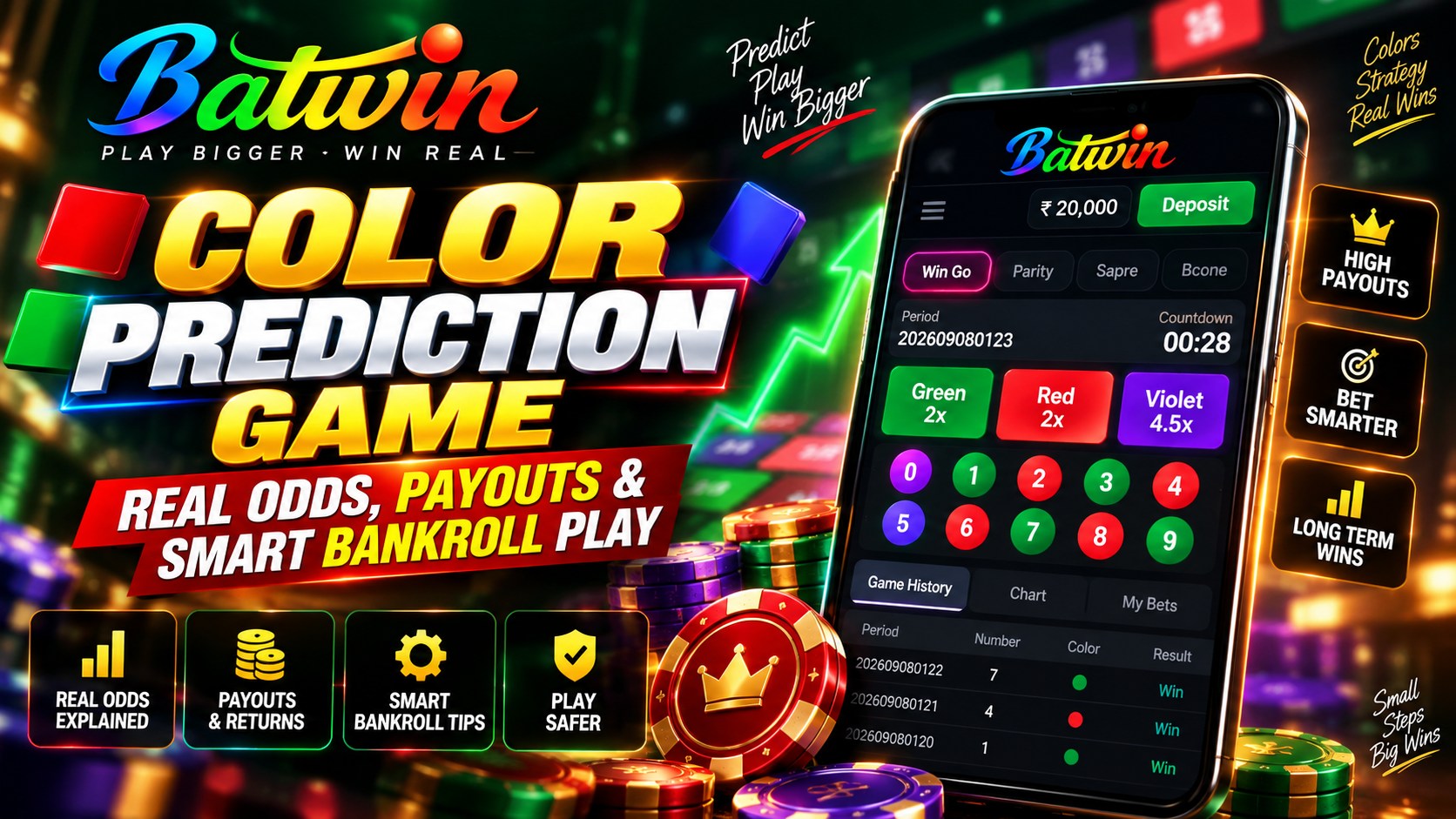
Color Prediction draws a random number (0–9) each round and maps it to a color — usually green, red, or violet. Green and red pay 2x, violet pays around 4.5x, and the payout structure is built so the platform keeps a small edge regardless of which color you pick. There is no reliable "pattern" — every round is statistically independent. Play it as fast, low-stakes entertainment with strict bankroll limits, not as a system to beat.
What the Color Prediction Game Actually Is
Color Prediction belongs to a family of games sometimes called "number games" or "color trading games" — fast, round-based games where a new outcome is drawn every 30 to 60 seconds. Each round follows the same simple loop:
- A countdown timer starts — typically 30, 60, or 180 seconds depending on the game mode.
- You place a bet on a color (green, red, or violet) or, on some modes, a specific number (0–9), before the timer runs out.
- The timer hits zero and a random number between 0 and 9 is generated.
- That number determines the color for the round via a fixed mapping (covered below).
- Winning bets are paid out at that color's multiplier; losing bets are forfeited. A new round begins immediately.
The appeal is obvious: rounds are short, the choice is simple (pick one of two or three options), and the feedback loop is instant. That same speed is exactly why it's easy to lose track of how much you've bet in a session — something worth keeping in mind before you dive into strategy.
The Number-to-Color System Explained
Every round's outcome is a single digit from 0 to 9, and each digit maps to a color. While exact house rules can vary slightly between platforms, the standard mapping used across most color prediction games is:
| Number | Color | Payout Multiplier |
|---|---|---|
| 1, 3, 7, 9 | Green | 2x |
| 2, 4, 6, 8 | Red | 2x |
| 0 | Violet + Red | 4.5x (violet) / 1.5x (red) |
| 5 | Violet + Green | 4.5x (violet) / 1.5x (green) |
Notice that 0 and 5 are "dual-color" numbers — they count as violet, but also partially count toward red and green respectively (at a reduced multiplier if you'd bet the secondary color). This is the mechanism that keeps green and red each covering roughly half of all outcomes, while violet — which only comes from two specific numbers — covers a smaller slice at a much higher payout.
How Payouts & Odds Really Work
This is the part that matters most, and the part most players never actually calculate. Let's do the math honestly, using the standard structure above.
Green or red: roughly 45% true probability, 2x payout
Green wins on 1, 3, 7, 9 (4 numbers) plus a partial share of 5. Out of 10 possible numbers, green-related outcomes happen a little under half the time — yet it only pays double your stake. If green paid out at exactly the fair rate for its true probability, it would need to pay roughly 2.2x–2.3x to break even for players over the long run. Paying 2x instead of that is precisely where the house edge lives.
Violet: roughly 10% true probability, ~4.5x payout
Violet only wins on 0 or 5 — 2 numbers out of 10, so its true probability is about 20% including its dual-color overlap, but as a standalone bet type it behaves closer to a 1-in-10 to 1-in-5 shot depending on how the platform structures dual-color wins. A "fair" payout matching that probability would need to be higher than 4.5x for a pure 1-in-10 shot — the gap between what a fair payout would be and what's actually offered is, again, the house edge.
"Patterns" Players Chase — and Why They Don't Work
Scroll through the result history in any color prediction game and it's tempting to see rhythm in it — "green hasn't hit in 6 rounds, it's due," or "the last 4 rounds alternated, so the next one will too." This feeling has a name: the gambler's fallacy — the mistaken belief that past independent outcomes influence future ones.
Why the fallacy feels so convincing
- The human brain is built to find patterns, even in genuinely random sequences — it's a useful survival trait everywhere except games of pure chance.
- Short streaks happen constantly in random data. A coin flipped 20 times will very often produce a run of 4–5 heads in a row purely by chance — that's expected, not a signal.
- Confirmation bias does the rest. Players remember the times a "pattern" worked and forget the many times it didn't.
Why it's mathematically true regardless
Each round's outcome is generated independently by a Random Number Generator (RNG). The RNG has no memory of previous rounds — it doesn't "know" green hasn't appeared recently, and it isn't "balancing out" anything. The true probability of green on the next round is exactly the same whether the last five rounds were all green or all red. This is a mathematical fact about independent random events, not a platform-specific claim.
A Realistic Probability Breakdown
Putting the true odds and payouts side by side makes the house edge concrete rather than abstract:
| Bet Type | Approx. True Probability | Payout | Edge Direction |
|---|---|---|---|
| Green | ~45% | 2x | House-favored |
| Red | ~45% | 2x | House-favored |
| Violet | ~10% | ~4.5x | House-favored |
| Exact number (0–9) | ~10% | ~9x | House-favored |
Notice the pattern across every single row: the payout is always set a little below what the true probability would require for a perfectly fair (zero-edge) game. This is completely normal — it's how every casino-style game funds itself, from roulette to crash games — but it's worth seeing in plain numbers rather than assuming any bet type is "the smart choice."
Play It Smart, Not Superstitious
Download the Batwin APK, claim your ₹10,000 welcome bonus, and set your session budget before you place a single bet.
Smart Bankroll Strategies for Color Prediction
Since no betting pattern changes the underlying probability, the only thing genuinely within your control is how you manage your stake. That's where real strategy lives for this game.
- Use flat bet sizes, not escalating ones. Systems like Martingale (doubling after every loss) feel logical but require an unrealistically large bankroll to survive a bad streak — and streaks of 6–8 losses happen more often than intuition suggests.
- Set a fixed session budget before you start and treat it as the absolute ceiling, not a starting point to top up.
- Cap each bet at 1–2% of that budget. The same rule that protects a bankroll in Aviator applies here — small, consistent bets survive variance far better than large ones.
- Decide your stop-loss and stop-win in advance, and actually walk away when you hit either one. Rounds finish in under a minute, which makes "just one more" the easiest trap in the game.
- Don't bet violet to "chase back" a losing session. Its higher payout is tempting after a string of losses, but it also has the lowest hit rate — a bad combination when you're already down.
- Track rounds played, not just wins and losses. Because rounds are so fast, it's easy to lose count of how much total time and money you've committed to a session.
The Flat Bettor
Same small stake every round on green or red. Lower variance, steady pacing, easiest to track mentally over a session.
The Session Timer
Plays for a fixed number of minutes or rounds, then stops regardless of outcome — removes the "just one more round" trap entirely.
The Occasional Violet
Sticks mostly to green/red, but allows a small, pre-budgeted violet bet occasionally for the higher payout — never as a loss-chasing move.
The Hard Stop-Loss Player
Whatever the style, this player never overrides their own stop-loss "just this once" — the single habit that matters most long-term.
How It Compares to Aviator & Teen Patti
Understanding where Color Prediction sits relative to Batwin's other popular games helps you choose what actually fits your style:
| Game | Round Length | Skill Involved | Decision Points |
|---|---|---|---|
| Color Prediction | 30–60 seconds | Minimal | One bet per round |
| Aviator | Seconds (variable) | Moderate | Bet size + cash-out timing |
| Teen Patti | 1–3 minutes | Higher | Multiple bets, reads, folds per hand |
Color Prediction is the fastest and simplest of the three — there's no cash-out timing to master and no opponents to read. That simplicity is the appeal, but it also means the outcome leans almost entirely on chance rather than skill, which should shape how much of your bankroll and time you dedicate to it relative to a more decision-driven game.
5 Mistakes That Drain Your Balance Fast
- Doubling down after a loss to "get even." This escalates risk exactly when your remaining bankroll is smallest.
- Betting based on the visible result history. Past rounds carry zero information about the next one — treating them as a signal is a guaranteed long-run loser.
- Losing track of round count. Because rounds are so short, it's easy to play 50+ rounds without realizing how much total stake that represents.
- Paying for "prediction" bots or signal channels. No external tool can predict a certified RNG — this is pure cost with zero edge.
- Treating a lucky session as proof of a working system. A short winning streak on a genuinely random game is expected to happen sometimes — it doesn't validate a betting pattern.
How to Play on Batwin
- Download the Batwin APK — grab it free and safe from the download page.
- Register with your mobile number and complete quick verification.
- Claim your ₹10,000 welcome bonus on your first deposit — see our full bonus breakdown if you want to understand the wagering terms first.
- Open Color Prediction from the games lobby and set your session budget before your first bet.
- Bet, watch the timer, and withdraw responsibly — instant UPI payouts are covered in our withdrawal guide.